
Logistics / Delivery management
A delivery management workflow: from order to doorstep
A connected delivery platform for the people moving every order forward.
- Fictional team
- 12 drivers · 2 dispatchers
- Example volume
- 120 delivery orders per working day
- Solution illustrated
- Dispatch website + driver app
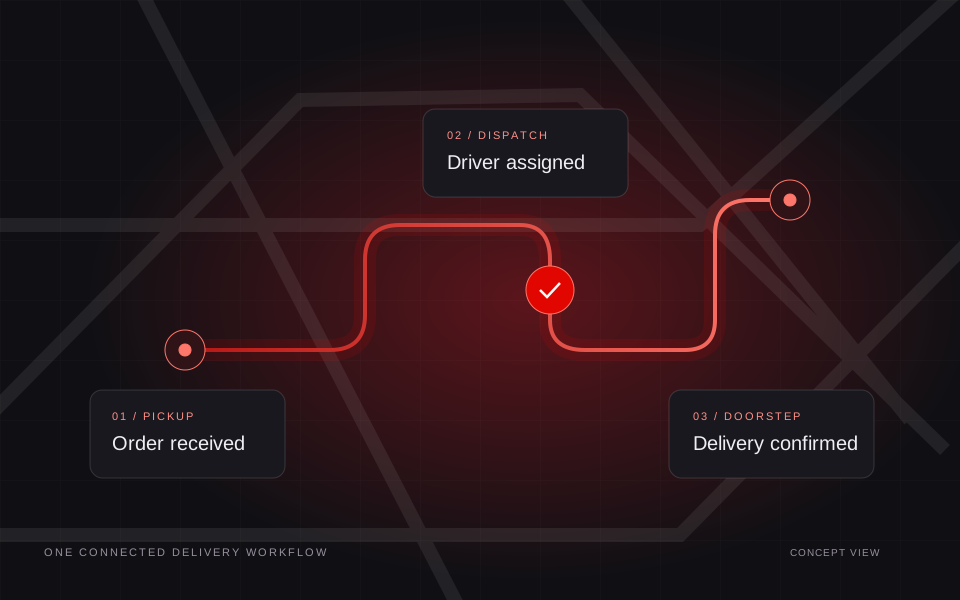
Plan the delivery handoffs
List who owns assignment, cancellation, failed delivery, and proof-of-delivery review. Establish which updates must work with limited connectivity and how conflicting changes are resolved. Use this fictional example to prepare requirements for workflow automation.
01 / The issue
The orders grew.
The process didn’t.
In this fictional scenario, a regional delivery company serves local retailers with 12 drivers and two dispatchers. The team handles 120 orders each working day, but coordinates them through spreadsheets, messaging apps, and phone calls.
Every order is copied between tools. A changed address may reach a driver but not the dispatcher. A delivery photo may stay in a chat thread. Customers call the office because nobody has given them a reliable way to check progress.
- Duplicated work: dispatchers retype order details and manually assemble daily reports.
- Unclear ownership: reassigned deliveries are difficult to follow across conversations.
- Missing evidence: confirmation photos and recipient details are not consistently attached to orders.
- Slow exception handling: an unavailable customer can leave an order waiting without a clear next action.
The business objective
Give every order a clear owner, a trustworthy status, and a complete delivery record—while reducing routine coordination work.
02 / The solution
One order.
One shared source of truth.
The example solution brings order intake, dispatch, driver updates, and delivery confirmation into one connected platform. It replaces the need to reconstruct an order’s history from several conversations.
- A dispatch workspace for the office
- Validated order entry and imports, driver assignments, searchable delivery histories, and a queue for work that needs attention.
- A focused mobile app for drivers
- Assigned stops, clear handling instructions, large status buttons, and proof-of-delivery capture with an offline update queue.
- A tracking page for customers
- A private order link with milestone updates and delivery confirmation. It shows the latest recorded status, not continuous GPS tracking.
- An operational view for managers
- Daily order counts, late deliveries, failed attempts, missing records, and exception reasons in one reporting view.
The first release deliberately leaves out automated route optimization, payments, and predictive AI. In this scenario, the immediate need is dependable daily execution—not a larger feature list.
03 / The delivery journey
From a new order
to a confirmed doorstep.
Here is how the fictional platform changes the work for dispatchers, drivers, and customers.
Receive the order
An order enters through a staff form, an import, or a connection to the existing sales system. Required addresses and contact details are checked before dispatch.
Assign the right driver
The dispatcher reviews the order and assigns a driver. The driver receives the pickup location, delivery address, and handling instructions in the app.
Keep everyone updated
The driver marks the order as collected or out for delivery. The dispatch view and customer tracking page reflect the latest update. Notifications can be sent at agreed milestones.
Confirm delivery—or flag a problem
The driver records proof of delivery, such as a photo or recipient confirmation. If nobody is available, they select a reason and return the order to an exception queue for the team to resolve.
Review the day
The owner sees completed deliveries, pending work, failed attempts, and orders needing attention. These records help the team spot where its process needs to improve.
04 / Implementation challenges
Designing for the road.
Not just the screen.
The fictional rollout begins with workflow interviews, a clickable prototype, and a trial with three drivers. After simplifying the app, the example team expands to all 12 drivers for the sample reporting period.
- Challenge: unreliable mobile connectivity
- Response: save updates on the device, show whether they are waiting to sync, and retry safely. Unique update identifiers prevent a retry from creating duplicate delivery events.
- Challenge: inconsistent order information
- Response: validate required fields, flag duplicate order references, and send incomplete addresses to a review queue before a driver is assigned.
- Challenge: changing familiar habits
- Response: replace a long driver form with task-focused buttons, test with drivers during a small trial, and use short hands-on training. Dispatchers keep a documented fallback for outages.
- Challenge: updates arriving in the wrong order
- Response: keep event timestamps and an audit history, enforce valid status transitions, and flag conflicting changes for review instead of silently overwriting them.
- Challenge: delivery proof contains personal information
- Response: restrict staff access by role, expire customer links, and define retention rules. Public tracking does not reveal internal notes, other customers’ details, or unrestricted delivery photos.
These are design choices within the demo narrative, not a claim that a real deployment or security assessment has taken place.
05 / Business benefits
Less chasing.
More clarity.
The example connects each feature to a practical benefit for the person using it.
- For dispatchers: time to resolve the unusual
- One work queue replaces repeated copying and status checking, leaving more attention for address problems, reassignment, and delayed orders.
- For drivers: less administrative friction
- Instructions and confirmation steps sit beside the assigned job. Drivers do not need to search old messages to reconstruct a delivery.
- For customers: fewer unknowns
- A tracking link answers routine progress questions. Milestone notifications make it clearer when a delivery is on its way or needs attention.
- For managers: a process they can improve
- Consistent records expose recurring exception reasons and incomplete handoffs, making operational reviews more useful than a manually assembled total.
06 / Sample results & numbers
What improvement
could look like.
All numbers in this section are invented dummy data. They illustrate how a case study could report results; they are not observations, a forecast, or a guarantee.
Less manual order handling per 20 working days.
Fewer calls asking for delivery status.
Increase in the on-time delivery rate.
A like-for-like example
The fictional baseline and pilot each cover four weeks: 20 working days, the same 12 drivers and two dispatchers, and 2,400 delivery orders. The comparison assumes a similar order mix and delivery area.
| Measure | Before | After | Improvement |
|---|---|---|---|
| Average manual handling per order | 4.0 min | 2.5 min | 37.5% less time |
| Calls asking for delivery status | 210 | 126 | 40% fewer calls |
| Orders missing required delivery proof at period close | 192 (8%) | 48 (2%) | 75% fewer records missing proof |
| Orders with a failed first attempt | 144 (6%) | 96 (4%) | 33.3% fewer affected orders |
| Orders delivered within the agreed window | 2,016 (84%) | 2,232 (93%) | +9 percentage points |
How the numbers add up
- 60 staff hours: (4.0 − 2.5 minutes) × 2,400 orders ÷ 60. Manual handling means active staff time on order entry, assignment, and record updates—not driving time or elapsed delivery time.
- 40% fewer calls: (210 − 126) ÷ 210 × 100. This counts status inquiries, not every support call.
- Proof completeness: 144 fewer orders lack required proof at period close. Rates use all 2,400 orders as the example denominator.
- On-time delivery: 93% − 84% = nine percentage points, or 216 additional on-time orders. This is not the same as a 9% relative increase.
Time recovered is not cash saved
The example releases capacity for other work. It does not establish a payroll reduction, revenue increase, return on investment, or payback period. Those would require actual costs and verified business data.
What a real evaluation would needUse time samples, call logs, timestamped delivery events, and proof-completeness checks. Keep metric definitions consistent and account for volume, weather, staffing, route changes, and customer mix. A before-and-after comparison alone would not prove that software caused every improvement.
07 / Further improvements
A useful first release.
A deliberate next step.
The demo still leaves 48 orders with missing proof and 168 orders outside their delivery window. Better visibility does not remove every operational problem. The next phase would focus on the remaining causes.
- First: improve address quality
- Add address confirmation and clearer location instructions for repeatedly problematic stops. Evaluate the change using failed first-attempt rates and dispatcher correction time.
- Next: strengthen pickup and handoff checks
- Introduce barcode scanning and a proof-completeness reminder. Track mismatched packages, missing proof, and how much time the added steps take drivers.
- Then: investigate route assistance
- Test suggested stop sequences against manual planning on comparable routes. Compare distance, lateness, and driver feedback before considering wider adoption.
- Explore: speech-to-text exception notes
- Trial short dictated notes while the driver is safely parked. Require review before saving, measure correction effort and recognition errors, and assess language support and privacy before rollout. This feature is not part of the sample results.
08 / What we learned
The workflow matters
as much as the software.
These are the takeaways illustrated by the fictional scenario, not lessons claimed from a real client engagement.
Agree on what each status means
“Delivered” needs a shared definition and appropriate confirmation. A dashboard cannot fix inconsistent definitions.
Make the driver’s next action obvious
A small, clear interface is more useful in the field than a crowded feature set. Design around the task, device, and working conditions.
Design the exception path early
No signal, a wrong address, and an absent recipient are part of the workflow. Give each a next action and an accountable owner.
Define the baseline before changing the process
Choose the measures, denominators, and reporting period first. Distinguish percentage changes from percentage-point changes.
Earn the next phase with evidence
Validate the everyday workflow before investing in advanced automation or AI. Adoption and data quality determine whether those additions will be useful.
Demo content for reviewThis case study is ready to review as a complete fictional example. Before presenting it as a real success story, replace the narrative and dummy figures with permissioned client details, actual scope, and verified evidence.